Monday, May 8, 2017

Day 4 of Traveling North via the Blue Ridge Parkway 2017

Saturday May 6th, 2017

Our friend’s house is on a cove on one of the northern fingers of Lake Sinclair. The sun comes up on the road side (people living on the lake call that their back yard), but it still shines brightly on the lake, or the view from their front yard. It was an awesome view for our departure day. It was sad, but also happy ... because we did get to spend time with them!

We headed back on to Route 441, just south of Eatonton Georgia. Traveling along 441, you enter the Oconee National Forest. It provides outdoor recreation opportunities and natural resources in Georgia. Featuring over 850,000 acres across 26 counties, with thousands of miles of clear-running streams and rivers, approximately 850 miles of recreation trails, and dozens of campgrounds, picnic areas, and other recreation activity opportunities, these lands are rich in natural scenery, history and culture. I guess you could say you could get lost in the Oconee National Forest, and you would not be kidding!

When you enter the town of Bishop Georgia, the first thing you see is the Bishop house. It is the start of the Southern charm that abounds as you enter the Historic District of Bishop. Originally known as the "Greenwood Community", the town of Bishop, Georgia sprang to life because of the railroad.  The line was originally designed to run from Knoxville, Tennessee to the Florida coast "through Macon and Covington", and thus was given the name the Covington and Macon Railroad.  However, the northern terminus changed from Covington to Athens, and that brought the railway directly through Bishop. In 1897 Mr. Seymour Durham Fambrough and his wife Janie purchased the property across from the railroad and sometime later began construction of a grand Queen Anne Victorian home.  Their intent was to "create something grand and out of the ordinary."   By this time the town of Bishop was growing rapidly.  Cotton was king and farmers were growing more and more of it every year.  The railroad, now called the Central of Georgia railway, transported cotton out of Bishop and brought goods, from around the country, back to the prospering farmers. During the period the house was under construction, Fambrough also had a store built, less than ten feet away from the house.   Both were built in a similar style and are believed to have been constructed by the same contractor, Howard S. Ash.  The store sold general merchandise and at the back of the store was a bank, "complete with bank vault".  The store was torn down sometime around 1918 but sections of brick, marking the foundation of the store, can still be found in the driveway. Two northbound trains and two southbound trains stopped at the depot each day.  For many, the first sight that greeted them to the town of Bishop was the beautiful Victorian home.

In Athens, Georgia there is the Sandy Creek Park & Nature Center - Sandy Creek Nature Center is a gateway to outdoor exploration.  The property features 225 acres of woodlands and wetlands with over 4 miles of trails, including an ADA interpretive trail and connections to the North Oconee River Greenway and Cook's Trail. The Education & Visitor Center includes live reptiles, amphibians, marine and freshwater aquariums, interactive natural history exhibits, and an incredible resource library, all housed in an eco-friendly building.  There is also a circa 1815 log house and several wildlife observation areas on site. This 782-acre park surrounds 260-acre Lake Chapman and offers a variety of activities throughout the year.  Athens-Clarke County takes pride in providing the community with facilities like those of many state parks.

In Commerce, Georgia there was a big back up on 441. Once we got close enough to the overpass of US 20 we discovered that there was a truck was on fire. It is amazing, how much one vehicle can back up traffic in both directions!

Fort Hollingsworth was erected in 1793 in Banks County, Georgia near the town of Alto, as a colonial defense establishment for local settlers in the area.  Fort Hollingsworth is listed on the National List of Historic Places and operates as an open-air museum that is free to visit. An annual celebration, A Day at the Fort, is held every year on the Saturday of Memorial Day weekend to celebrate local Appalachian heritage. The White House, Joshua White and Katharine Lane White obtained the fort and made it their home. They built the addition to the two story single pen that had been the fort and made it look like any other farmhouse of the mid 1800’s. The addition was linked to the original structure by a covered walkway, known as a dogtrot. Fort Hollingsworth-White House looks very much today as it did in the 1860’s.

As we drove through Mt Airy, Georgia it is the first time that we get our first real sighting of the Blue Ridge Mountains. It is a sight that I can never get tired of ….

Warwoman is a 15,800-acre Wildlife Management Area within the Chattahoochee National Forest. It is open to hunting deer, hog and bear during managed hunts. There is also the opportunity for turkey, small game, and furbearer hunting. The area offers scenic landscapes for picnicking, hiking, camping, fishing, bird-watching, and horseback riding. Trout fishing is available at Hood Creek, Walnut Fork Creek, Sarah's Creek and tributaries of each. It is an awesome place for the outdoors men and women of northern Georgia.

Black Rock Mountain State Park is a 1,743 acre Georgia state park located west of Mountain City in Rabun County, Georgia. It is named after its sheer cliffs of dark-colored rock in Georgia's Blue Ridge Mountains. Located astride the Eastern Continental Divide at an elevation of 3,571 feet, the park provides many scenic overlooks and vistas of the southern Appalachian Mountains. On a clear day, four states are visible: Georgia, North Carolina, South Carolina, and Tennessee. In addition to Black Rock Mountain itself, the park includes four other peaks over 3,000 feet in elevation, making it the highest state park in Georgia.

Dillard Georgia always makes me smile! We have many great memories in this area. My memories are from a couple of different visits. Once with Jackie, Karen and Wayne. The other visit with Pattye and Bully! Both of the visits involved a trip to the infamous Dillard House, a family style restaurant.

 There are also two places that sell all kinds of yard art. I am sure that we could find kin for Maudine, Maynard, Gunny, Pinky, Tiny and all our Geek-E-Birds! But, we have no space to pick one up on this leg of our trip!

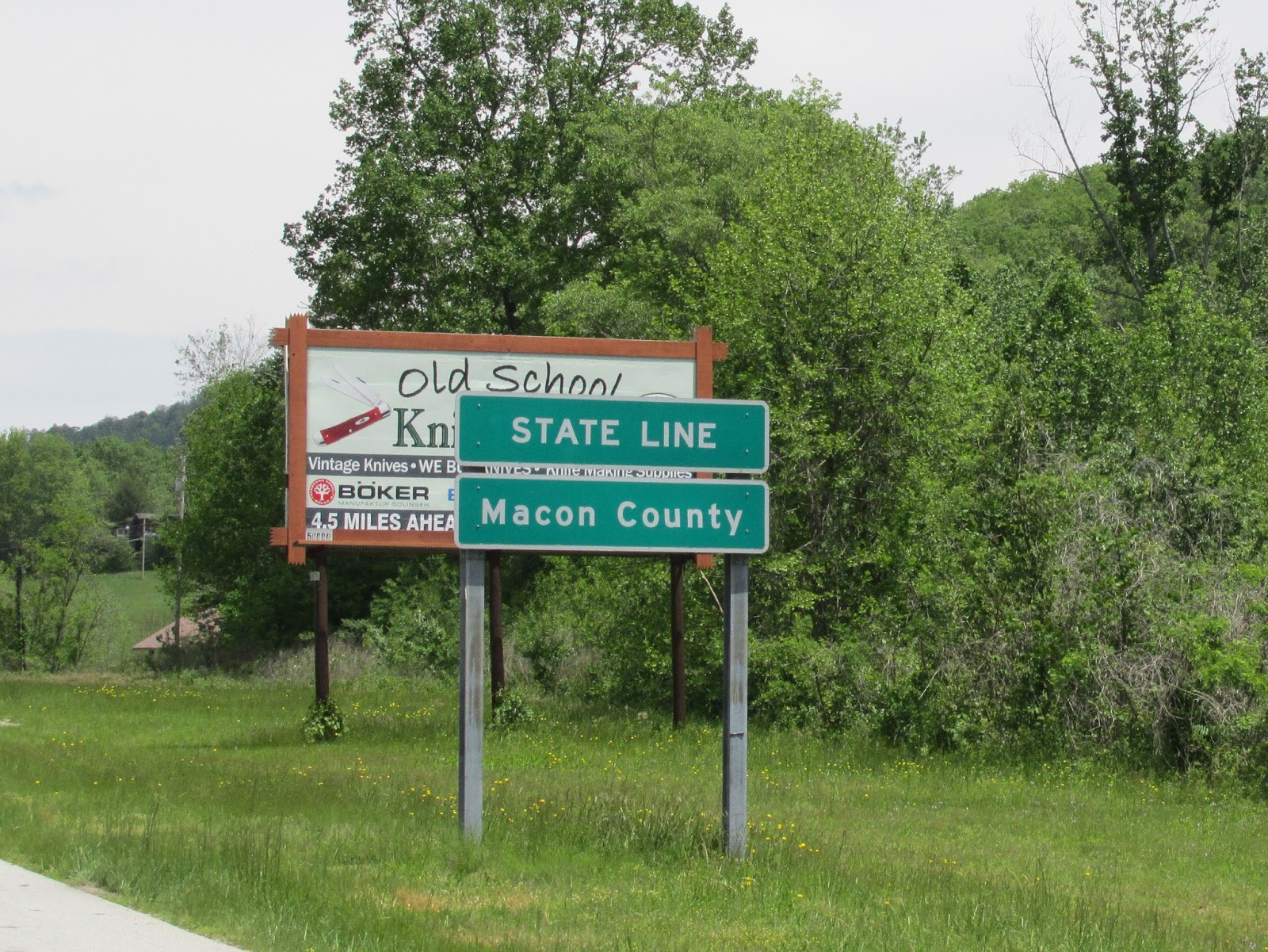
Just north of Dillard is the Georgia and North Carolina state line.

Within a couple miles of each other on Route 441 there is a Cherokee Defeat historical marker on the northbound side and a Cherokee Victory historical marker on the southbound side. Grant had arrived in America in 1757 as the major of Montgomery’s regiment, the 77th Foot, more aptly known as Montgomery’s Highlanders. Impetuous, Grant led a disastrous attempt to take Fort Duquense in Pennsylvania from the French in 1758 that resulted in his capture as well as the destruction of nearly 30 percent of his force. 
Exchanged in 1759, Grant returned to the British army and was appointed lieutenant-colonel of the 40th Foot, although he was soon detached from his regiment to lead a new expedition against the Cherokee. On June 10, 1761, a 2,800-man army led by British Lieutenant Colonel James Grant defeated a Cherokee force led by Chief Oconostota in an engagement known as the Second Battle of Echoe near present-day Franklin. The battle took place only two miles from the location of the Cherokee defeat of Colonel Archibald Montgomery’s force the previous year in the First Battle of Echoe.

Near Franklin North Carolina, I found two "Purple Things We See." 
A Rock shop and a port-a-potty! Quite a combination!

Route 441 joined with 23, it is also known as the Appalachian Highway. We followed the line of the mountains into Cherokee, North Carolina. We traveled through the Oconaluftee Indian Reservation on our way to our overnight stop. The school is home to the “Lady Braves.” 

The rain had just begun to fall as we got close to the Cherokee / Smokey Mountains KOA.

Sunday, May 7, 2017

Day 3 of Traveling North via the Blue Ridge Parkway 2017

Friday May 5th, 2017

We decided to spend a bonus day with our friends at Lake Sinclair. The weather was overcast and cool … so a boat tour of the lake was out … a tour of Madison Georgia sounded like a great idea.

Madison has been voted the "#1 Small Town in America" by Travel Holiday Magazine and one of the "Top 16 Most Picturesque Villages in the World.” Madison is labeled as Georgia's "authentic Southern town," with an array of local dining options, more than 45 specialty shops and more than 160 antique dealers. Madison retains its small-town character and remains the heart of the community. Downtown Madison is punctuated by a central town square and anchored by historic government facilities, such as City Hall, the Morgan County Courthouse, and U.S. Post Office. The Chamber of Commerce, located on the square, has a great vantage point to view the bustling retail, professional, and service businesses.

We stopped at a consignment flea market in an old manufacturing building on 441. We were hunting for bedroom night stands and salt and pepper shakers. Our friend was looking for the nightstands … we have no room for them in our motorhome! Our friends ended up with a sign for one of their sons! We headed downtown into the heart of Madison to walk, talk, window shop and stop into many of the antique shops and boutiques.

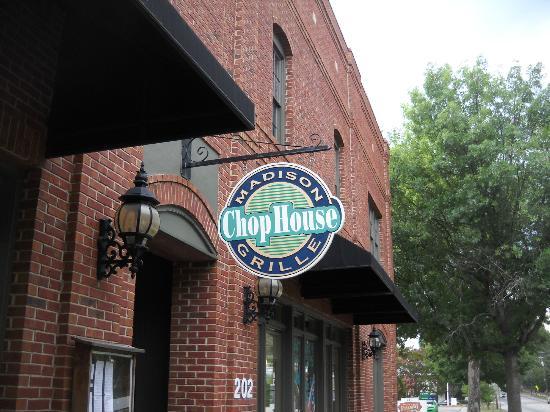
After a bit of shopping, we stopped into the Chop House Grille, for a late lunch! My friend kept raving about the chicken salad … so, I had to try it! Charlie had a BLT. Terry enjoyed a Magnolia salad!

On a day with sunshine and warmer weather, you can pick up a brochure, and begin your self-guided walking tour of the more than 50 antebellum sites in the city's downtown historic district. Since it was still misting after lunch, we drove around to see a few of the homes.

Friday was also the first day of the 2017 Spring Season in Grand Style with the region’s most popular tour event:  the Madison in May Spring Tour of Homes and Gardens.  A collection of the city’s finest, architecturally significant homes (1810 – 1996) and intimate gardens, including the largest private moss garden in America. Tour attendees allow visitors to take a step back in time and experience the living Southern history of Madison.  These grand structures and gardens tell the story of a genteel, gracious city – Madison, Georgia.  This truly will be a tour to remember! The tour tells the story of these grand structures that are still standing, some more beautiful and sound than ever. Generations of owners have been dedicated to preserving not only the house, but the gardens and outbuildings as well.  Owners of these historic homes cherish and care for the property, sometimes adding, sometimes taking away.  While, other families have chosen to build newer homes in authentic historic style.  In either case, each home on this year’s tour is a fascinating blend of the past and present, while reflecting their own unique story.

The Rogers House and Rose Cottage, it was built in 1809, the Rogers House is Madison's oldest home. Heritage Hall is an impressive structure. It becomes even more striking when you learn that the building didn't always occupy its present location. The 1811 Greek revival mansion sat on a lot 200 feet away until it was dragged over logs to the current site in 1908. There is many historic homes for sale in Madison, but one caught our eye. It is across from the Chop House Grill, where we ate lunch. 

The "Dove-Cote House", circa 1830. It is a 6,000 square foot home in the downtown historic district of Madison. It is an original plantation plains home with Victorian detail added in 1885. It can be purchased for only $899,000! Or if you want more space, how about the completely restored historic Higginbotham house, boasting 4 or 5 bedrooms on 7.2 acres. The price is right for only $1,195,000!

Established in 1809, Madison is the seat and the largest town in Morgan County. The early town flourished as a stagecoach stop and an in-town residence for planters' families. Streets were patriotically named for presidents and the community prided itself on its schools, literary, and philosophical societies. For the most part, Madison's antebellum architecture survived because Mayor Joshua Hill, a strong Unionist who had resigned his Congressional seat in 1861 to return to Georgia, developed a gentlemen’s agreement with General Sherman's detachment. Which is why Madison is the town General Sherman refused to burn.


We would have loved to tour longer, but the cool weather and mist were not cooperating with us today.

Saturday, May 6, 2017

Day 2 of Traveling North via the Blue Ridge Parkway 2017

Day 2 - Thursday May 4th, 2017

After a restful night and a bit of hiking we departed General Coffee State Park. Before we go, I should tell you about the trails at the park. There are 4 designated walking trails and 12 miles of horse trails. The walking trails are an interpretive walk around the Heritage Farm loop; the Gopher Trail; the East and West River Trails. The river trails take you along the Seventeen Mile River, which is an ephemeral (also called black water, due to its dark tea colored hue.) The Gopher loop takes you to the Sandhill management area of the park. Scattered throughout this area are Gopher Tortoise colonies, each colony can contain 10 to 15 burrows and be home to 10 tortoises.

As the sun was rising, we were traveling on Highway 32 W we got back to Douglas Georgia and back onto 441 N. In this area, 441 is also known as ‘Max Lockwood Memorial Corridor.’ Who is Max Lockwood? The late Max Lockwood served in many capacities, mayor of Douglas, president of the Douglas Rotary Club, and chairman of the Georgia Environmental Facilities Authority. Still most know him for his work to improve transportation. He felt that 441 needed to have four lanes. He devoted his time to making that happen not just for the portion that ran through South Georgia, but for all communities along U.S. Highway 441. For that, lawmakers decided to dedicate the section of the highway from Douglas to the Ocmulgee River Bridge to his memory.

Along 441 there is an old farmhouse on the northern outskirts of Broxton. It features a mural painted by Dylan Ross. Dylan is a native of Coffee County and he has four murals in Douglas and Coffee County. The barn has an iconic scene from The Andy Griffith Show and an oversized face of Barney Fife! His work is really fresh and colorful and he’s a working artist in the sense that he’s always creating art. He really enjoyed doing it and was happy that it brings joy to passersby on 441.

US 441 crosses over the Ocmulgee River. There was a sign for the Ocmulgee River Trail. I wondered where you could enter to walk the trail. I learned that the trail is actually about 200 miles of water trail stretching from Macon to the river's union with the Oconee River. It is a trail for canoe and kayakers! The trail has 23 access points and offers those that venture on the trail mostly flatwater with Class 1 rapids. 

Along the banks of the Ocmulgee River the Horse Creek Wildlife Management Area is found. Hunters have access to thousands of acres of hunting land and primitive camping is allowed in designated areas. Montgomery Lake is an oxbow off the Ocmulgee River. Montgomery Lake is home to the world record Largemouth Bass. The bass was caught June 2, 1932 by George W. Perry with the bass weighing 22 pounds 4 ounces. This record helps draw fishermen to this area of Georgia. 

Aside from the world record Largemouth Bass, Jacksonville, has a rich history. They have many handmade signs talking about all of their history.

We have seen the “original” Statue of Liberty, we have even seen one in the middle of the Susquehanna River. But I did not expect to see one in a small town in Georgia! The Telfair County War Memorial in McRae has a handmade miniature Statue of Liberty, as well as a listing of the sons and daughters of the county who lost their lives defending our nation. 

McRae also has a Coca-Cola Bottling Company. This company has been in operation since 1905. They distribute over 750 refreshing beverages, including Coca-Cola, Coke Zero, Diet Coke, Sprite, Fanta, Dasani Water, Powerade, Minute Maid, Vitamin Water and many more.

Little Ocmulgee State Park offers a beautiful golf course, a clubhouse, a lodge with a restaurant, camping, and a lake front recreation area. The lakefront portion was an old building, created in the 40's by the Civilian Conservation Corps, looks over a 200-acre lake. We will have to camp there sometime.

319 / 441 aka “Georgia’s High Tech Corridor” … really?! This was the most interesting set of signs in this stretch of 441 from McRae to Milledgeville. Now, when I saw the first of these signs, I figured we would see some high tech businesses. But by the time I had come to the second sign, I had seen nothing but tree farms and grass. This is a long stretch of Georgia between these 2 towns, and I never saw anything resembling any tech industry. There was a defunct microwave tower, but not much else. There were some old way-side businesses that have long since closed and fallen into disrepair, many with the roofs caved in. There was the occasional working farms. But more often, abandoned homes and businesses were the view. We did not see any thriving places of technology. That promise of a tech anything had not yet arrived here. It must be some hope or attempt to lure executives of Amazon or Google to consider building complexes along this stretch of roadway.

  
When we arrived in Dublin Georgia, right away I thought of our friends Bob & Marie. The original settlement was named after Dublin, Ireland. Originally, Dublin and the surrounding area was home to Native Americans of the Muskogee people. Most of the Muskogee fled westward with the arrival of European settlers. Despite the Irish ancestry of Dublin's first non-indigenous settlers, the town, like most of Middle Georgia, was a mixture of ethnicities. Most of the population descended from Scottish, English, and other western European immigrants. The considerable African-American population descended from most of whose roots lay in Angola or throughout West Africa. The banners hanging on Main Street depict the Irish ancestry of the area.

Also in Dublin, there are some awesome murals. Just outside of Dublin Georgia, our friend called. When they lived closer, she was not much of a cook, but she tells me since the closest store is 20 minutes away and restaurants without drive-thru’s are more than 30 minutes away, she has been cooking more. She called to tell us not to eat, she wanted to make us lunch … then she proceeded to tell me that she made Carolina Chicken salad … then she reached for the can of tuna, to make some tuna salad. The can was chicken … she reached into the garbage and discovered that she had made the Caroline Chicken Salad with Tuna … ooops! Oh well, we have never had tuna salad with apples and pecans … I’ll try anything once!

We traveled part of 441 about 8 months ago, when we were on our 2016 Rally Tour with some of our friends. We had left the Georgia Fall Good Sam Rally and were heading to Dillard Georgia and onto a Rally in Tennessee. There were some good times with friends, on that adventure too!

The city of Milledgeville has a rich history, especially for those interested in the history of the Antebellum South and the Civil War. Its history began in 1803, when the state of Georgia searched for a site for its new capital.  Because this area offered a central location and ample springs, it was the perfect spot. The planned capital city took shape and was given the name Milledgeville in honor of John Milledge, governor of Georgia and donor of the land for the University of Georgia. Located on the fall line of the Oconee River, Milledgeville is the only city in the US, with the exception of Washington DC, actually designed to be a capital city. For more than 60 years, it remained the capital, until it was moved to Atlanta.

There are still many die-hard confederates in this area. They were their "colors" proudly!


Lake Sinclair is a man-made lake near Milledgeville. It is owned by the energy company. Located in the central region of Georgia, on the Oconee River, Lake Sinclair stretches through the three counties. It was created in 1953 and offers 413 miles of scenic shoreline, winding coves and inlets as well as several vast stretches of open water. The lake encompasses over 15,000-acres and provides both electricity and recreation. Our friends have a home on Lake Sinclair, so we ventured off 441 and down some narrow roads to our friend’s house. We will be here for a few days!

Wednesday, May 3, 2017

Day 1 of Traveling North via the Blue Ridge Parkway 2017

We let the fog come in and lift before we headed out this morning on the first day of our 2017 Two Lane Adventure. We departed Majestic Oaks RV Resort and headed north on 301. We left Zephyrhills and passed through Dade City, past the old orange packing plant and the Pioneer Museum.


We saw a sign “Peanut Hay for sale.” What the heck is peanut hay? Perennial peanut, is a high quality legume hay, equivalent to alfalfa. It was developed and tested at the University of Florida, for horse consumption. Perennial peanut is a legume forage with large, oval leaves and beautiful orange/yellow flowers. Perennial peanut, also call forage peanut, looks similar to the annual peanut plant but does not produce the peanuts that we love to munch on.

In Bushnell, we have passed by this oversized steer on a trailer in a car dealership lot. I have often wondered what the back story to this animal is. But today, just like every other time, we still don’t know the answer! It is just a big (literally) mystery!

We passed through Coleman, Wildwood and into Oxford. Outside of Oxford, on the way to Ocala, is Oxford Downs. When Oxford Downs held its first races in April 2014, they were run on a track carved out of an empty field on the edge of the Marion/Sumter county line off U.S. Highway 301. Now, just over three years later, a 11,000 square foot poker room and tiki-bar now overlook the same track. The poker room includes 23 tables and several large screen televisions simulcasting thoroughbred races from around the country. It looks awesome from outside, when we are not traveling in the RV towing a Jeep, we will have to stop.

Just before Ocala, 27; 441 and 301 follow the same route into Belleview. In Ocala 27 heads more west and 441 and 301 remain together. 441 N breaks off north of Ocala and heads a bit more north-east. It is known as an Old Florida Heritage Highway. Just south of Gainesville, The Old Florida Heritage Highway spans 48 miles of roads through tree canopies draped with Spanish Hanging Moss and where the pace of life is unhurried. The sights and sounds are authentic small town Florida. Discovering Florida's natural beauty and the rich history of the area are just a stone's throw away. I learned, "It is the mission of  Old Florida Heritage Highway to preserve and promote the corridor, while fostering community involvement and educating visitors on the outstanding nature and unique features of this corridor."

We found Orange Lake and learned that ninety-five percent of the community is located in Marion County while the remaining five percent is located in northern neighbor Alachua County and the entire lake is located in Alachua County. But, it is managed by the Marion County Water Management Board.
                
Outside of Micanopy, you see a striking marble statue of an angel and pets. It is at the Garden of Love Pet Memorial Park. This memorial park understands the bond between owners and their pets and they provide a service dedicated to assisting owners through the transition of saying good-bye to a cherished family member. It has been there for almost 40 years.

The historic town of Micanopy, pronounced mick-a-no-pee. Founded in 1821, Micanopy is believed to be the oldest inland town in Florida and is named for Chief Micanopy of the Seminole Nation. You can enjoy lunch at the Old Florida Café. Toys and comics from all eras make lunch fun and a shopping delight. Venture next onto Choloka Blvd., also known as Main Street, which is lined with vibrant shops ranging from stained glass to antique furniture. Pick up an ice cream cone and enjoy the wonderful small town charm unfold before you. A couple of blocks from downtown Micanopy is the Historical Society Museum. From Native American history to turpentine processing to what a general store looked like. The Museum delivers a glimpse into what life was like in rural Florida. One of the interesting parts of the museum is the circa 1930's Coca-Cola billboard painted on the side of the museum itself. Few of these signs still exist at their original locations which makes this such a unique attraction.

On 441, we got a different view of Paynes Prairie. I never knew they had campsites! We traveled through the eco-passage into the over 20,000-acre preserve. It is among the most significant natural and historic areas in Florida. Retrace the trails of noted artist and naturalist William Bartram, detailed in his description of this area which he called the "great Alachua Savannah." The Prairie is home to herds of wild Bison and Horses as well as a wintering ground for Sand Hill Cranes.

441 took us through Gainsville and the University of Florida campus. There were many unique sights here.

The University of Florida sign.

An old “Arby’s” neon sign.

A sleeping homeless man, with his Sombrero, in front of a sorority house.

Adam’s Rib Co Gator pick-up truck.

In the midst of north Florida's sandy terrain and pine forests, you can find a gem … Devil's Millhopper Geological State Park. It is a bowl-shaped cavity that is 120 feet deep and leads down to a miniature rain forest. Small streams trickle down the steep slopes of the limestone sinkhole, disappearing through crevices in the ground. Lush vegetation thrives in the shade of the walls even in dry summers. A significant geological formation, Devil's Millhopper is a National Natural Landmark that has been visited by the curious since the early 1880s.

There are two Shrines in Florida for Our Lady of Le Leche. The original shrine in St Augustine and a second shrine in High Springs. It is called the Santa Fe Shrine of Our Lady of Le Leche and it is located at St. Madeleine Sophie Catholic Church. Since the early 1600s, this devotion has been kept alive by countless people of faith who travel to the oldest Marian shrine in the United States to seek the Blessed Mother’s intercession for a safe delivery of their child, for the gift of fertility, for those seeking to strengthen their faith and for many other special intentions. The Santa Fe Shrine of Our Lady of La Leche, grounded in the rich traditions of the shrine in St. Augustine, will provide people living in the western counties of the diocese and others traveling to Florida a place for pilgrimage and spiritual renewal.

We crossed the Santa Fe River. It is a more than 70-mile (121 km) river in northern Florida. This river has a unique characteristic, it completely disappears underground and then reappears 3 miles downstream. Actually, the river drops into a large sinkhole in O'Leno State Park and reappears in the adjacent River Rise Preserve State Park. A map of the watershed clearly shows the gap in the river where it flows underground.

The site of Lake City was a Seminole village named Alpata Telophka, meaning "Alligator Village". By 1830, a Euro-American town called Alligator was established, adjacent to the Seminole town. The city was incorporated and changed to its current name in 1859. The name was changed because the mayor's wife, who had recently moved to the town, refused to hang her lace curtains in a town named Alligator, so Lake City was born!

The Florida Georgia line is very uneventful on Route 441.

We were going to take a detour into the Okefenokee National Wildlife Refuge, and stay at the Stephen Foster State Park, but the current threat of the wildfires and the smoke in the area … we skipped it. 
The smoke was thick in many areas and the Incident Command was set up at a school in Fargo, GA. There were embers and ash in the air in Fargo. The Okefenokee National Wildlife Refuge has 353,981 acres of National Wilderness Area within the refuge boundaries. It conserves the unique qualities of the Okefenokee Swamp for all to enjoy.  The swamp is considered the headwaters of the Suwannee and St Mary’s Rivers.  Habitats provide for threatened and endangered species, such as woodpeckers, wood storks, indigo snakes, and a wide variety of other wildlife species.  It is world renowned for its amphibian populations.  More than 600 plant species have been identified in the refuge.


We camped our first night on the road at General Coffee State Park in Nicholls. It is one of southern Georgia’s best kept secrets. Along with 4 miles of hiking and 14 miles of equestrian trails, this park boasts a ton of agricultural history at its Heritage Farm. There are log cabins, a blacksmith shop, a corn crib, tobacco barn, cane mill. Barnyard animals and other exhibits. Seventeen Mile river meanders through a cypress swamp where you can find rare and endangered plants. The threatened indigo snake, gopher tortoises, pileated woodpeckers, armadillos, deer, fox and alligators make their homes in this wiregrass community within the park.