Showing posts sorted by relevance for query guidestones. Sort by date Show all posts

Wednesday, October 2, 2019

2019 Rally Route - Friday September 20th, 2019 – Day 12

This morning while we enjoyed our coffee on the patio, we got to watch the fog over the lake raise. It was a beautiful and calm view! 

Driving out to the Georgia Guidestones, we did not expect to come upon the “Granite Capitol of the World” in Elberton Georgia. I would have said the granite capitol was in New Hampshire. But more about that later.

The reason we were driving out here, was to see the Georgia Guidestones. Here is what we learned from our visit. In 1979, a man going by the name of R.C. Christian, certainly a pseudonym, approached the Elberton Granite Finishing Company with the task of building a monument. He said that no one was to ever know his true identity or that of the group that he was representing. He seemed to have an endless supply of money to fund the project and by the terms of the legal contract all plans had to be destroyed after completion and all information about him withheld from the public.

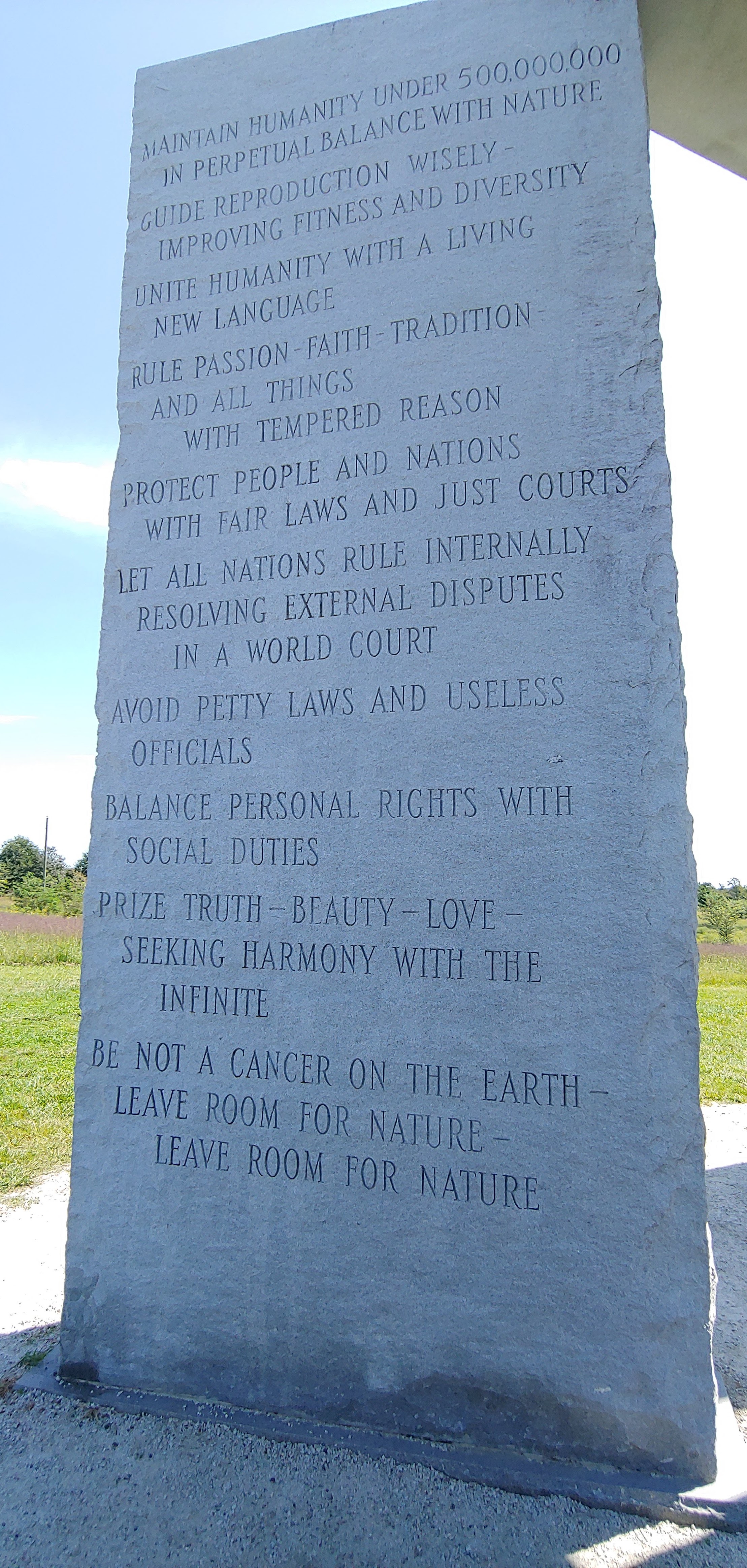
In 1980, the stones were finished. They carry a tablet in front proclaiming, “Let these be Guidestones to an Age of Reason.” Engraved in the stones are ten guidelines meant to reestablish the planet and society, perhaps after an apocalypse. They are written in eight different languages, English, Spanish, Swahili, Hindi, Hebrew, Arabic, Chinese and Russian.

The Guidestones also serve as an astronomical calendar, and every day at noon the sun shines through a narrow hole in the structure and illuminates the day’s date on an engraving. During an equinox or solstice, those who stand at the west side of a “mail slot” carved into the Guidestones can see the sunrise over the horizon. The four outer stones are positioned to mark the limits of the 18.6 year lunar declination cycle. An eye-level hole drilled into the center stone permits viewers to locate the North Star.

The names of four ancient languages are inscribed on the sides near the top: Babylonian cuneiform, Classical Greek, Sanskrit, and Egyptian Hieroglyphics.

Additionally an instructional tablet at the site speaks of a time capsule buried underneath the surface, though the dates on which the capsule was buried and when it is to be re-opened are missing. Whether this is intentional or the capsule was never buried is unknown.

R. C. Christian and his cohorts allowed the landowners full cattle grazing rights. In a small gesture of generosity, the mysterious backers of the Georgia Guidestones still permitted the owners of the land on which they were built to allow their cattle to graze on it for their entire natural lives—or until a nuclear war that wipes out 90% of the world’s population, whichever comes first.

The Guidestones continue to be a point of controversy. Conspiracy theorists and fundamentalists believe them to be the work of Satanists or the New World Order, fueled particularly by certain commandments such as “Guide reproduction wisely – improving fitness and diversity” which can be ominously interpreted and the Guidestones have been seriously vandalized by such conspiracy theorists. Others believe them to be a message of wise prophecy, possibly the work of an eccentric man of science. However, if the past thirty years are any indication, we may never know who built them besides what is engraved on the Guidestones itself: “Sponsors: A Small Group of Americans Who Seek The Age Of Reason.”

On the instructional tablet, Jackie found “information available: Elberton Granite Museum and Exhibit.” It is not a planned stop, but we are in town now, so we are stopping!

At the Elberton Granite Museum & Exhibit we browsed through the large exhibit space on three levels and followed the story of this industry. We watched a film that explained that Elberton Georgia produces over 50% of the monumental granite used in the US. There are more than 100 granite processing facilities in and around Elberton. The Elberton vain of granite is 35 miles long, 6 miles wide and 13 miles deep ….. that’s a lot of granite!
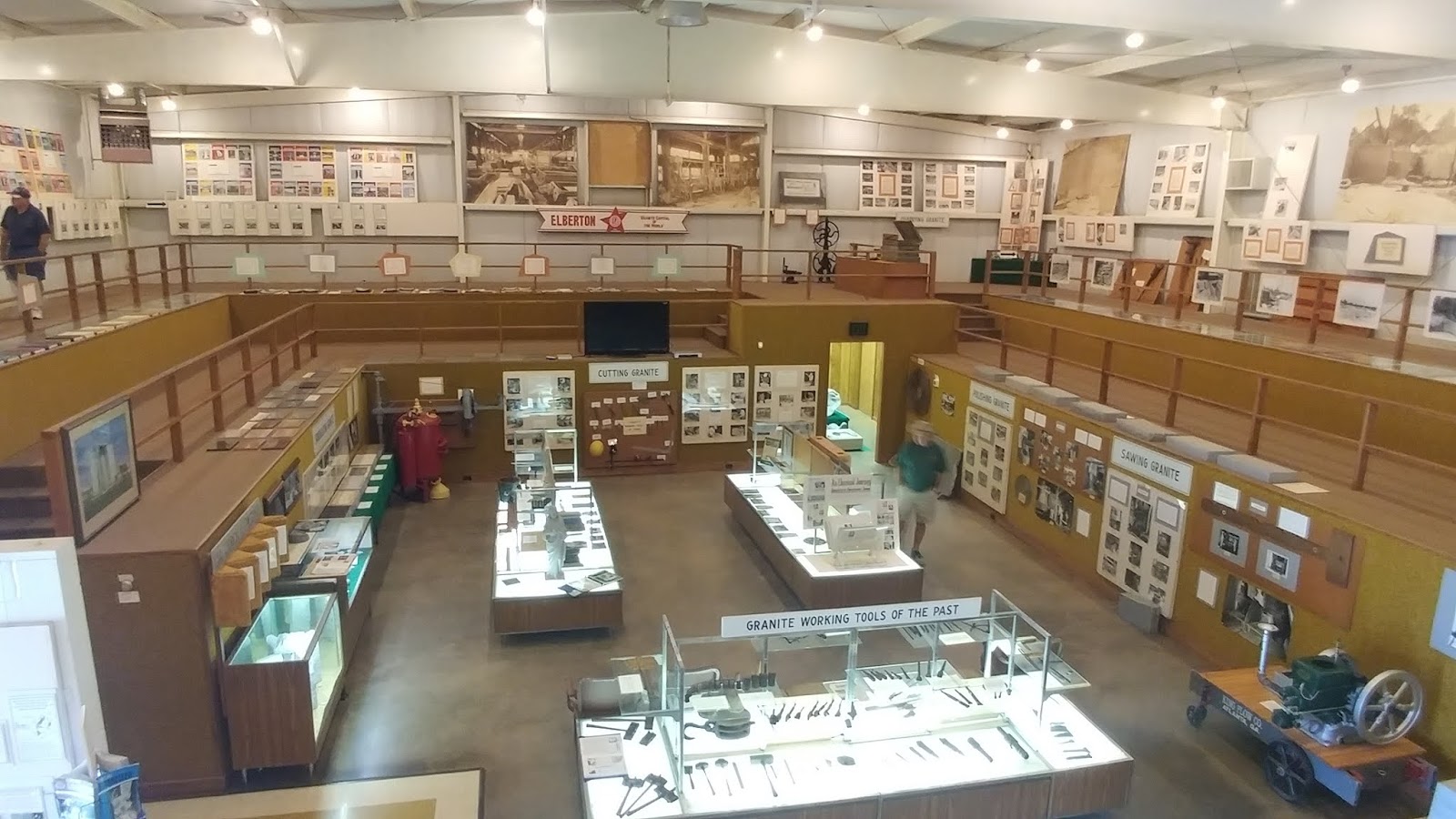
We saw unique granite products of the past, like “Dutchy,” antique granite working tools, yesteryear’s methods of cutting and polishing granite, quarrying tools, educational exhibits relating to current methods of quarrying. On the three levels of exhibits.

A little more about “Dutchy”, he once was the zenith of a 22-foot pedestal in Elberton’s city center, now a broken Confederate monument now occupies a side room in the Elberton Granite Museum and Exhibit. The sculpture’s story bears relevance in contemporary culture, given the ongoing “problems” with Confederate monuments and the call by some to dismantle them.

Like many Confederate memorials, Elberton’s was created decades after the Civil War ended. Sculptor Arthur Beter created the 7-foot-tall Confederate soldier in the 1890s, and the citizens of Elberton erected it on July 15, 1898. Soon after, the same people dubbed the statue “Dutchy,” a reference to his resemblance of Pennsylvanian immigrants of Swiss and German origins. This comes, in part, from his bulbous headgear and heavy coat.

According to local lore, Beter, the sculptor, was an immigrant to the United States who purportedly did not understand the difference between Union and Confederate uniforms. Compared to the more naturalistic soldier that replaced him and to this day marks the center of the city’s downtown square, Dutchy is stylistically crude, with a blocky body and generic face with wide-open almond-shaped eyes. He sports a droopy mustache that creates the appearance of a half-smile. One night the townsfolk toppled the statue to the ground. Dutch was buried in town square for several decades and a more proper memorial was erected.

The museum is home to the World's Largest Solid Granite Spire. The 51-foot high spire was originally erected at the ARGO trucking company, as a company symbol of the company started in Elberton. This spire is a single piece and is something to behold.

We’re told that this spire was a fluke, not an order or anything intended at all. The quarry that the spire comes from was simply trying to square up a cut and out popped this extraordinary one piece granite rock. The “ARGO” trucking company owner decided to buy it and he had it erected at the company offices where it stood proudly for years until the company was sold; the spire was then taken down, was transferred to the museum and re-erected.

From the Granite Museum, we headed to the Callaway Plantation. It is a 56-acre historic restoration project. It offers visitors a glimpse into the by-gone era of working plantations in the agricultural South. IT shares with guests, the intimate story of one family's legacy. At the Callaway Plantation can see, feel, and touch 200 years of Wilkes County history. Callaway Plantation humbly began with a log cabin built by Job Callaway in 1785 then grew to a 3,000 acre working plantation complete with a brick mansion by the 1860s.

It was gifted to the City of Washington by the Callaway family, the property is now home to six unique historical structures. The family's first home on the plantation was a log cabin built by Job Callaway in 1783.

It burned down, but a cabin of similar design from the same era has been moved to the site. It consists of one room with a sleeping loft. There was a family of six that lived in this small cabin.

The family's second home still stands on the site, a two-story Federal Plain style house that they built around 1790.

It features period furnishings and decorations. It is called the “grey” house, you can see why.
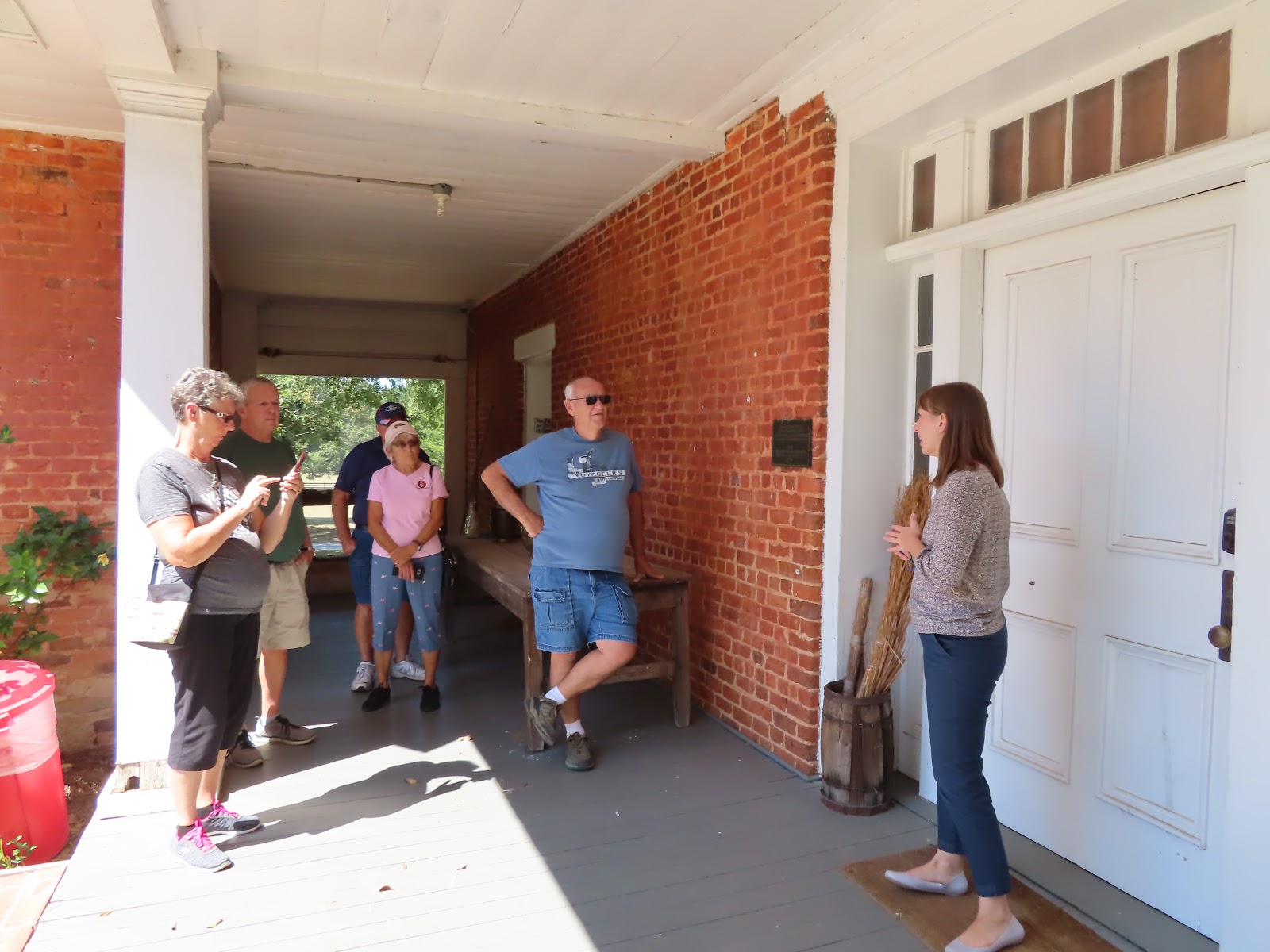
The main building is a brick mansion built by the Callaway family around 1860 out of Georgia red clay.

Some of the original furniture is in the house. There was a men's parlor and a ladies parlor at the front of the house with unique windows, that slide up and the bottoms opened out to create a small doorway to exit the room onto the wraparound porch during events at the home.

Other structures include an 1891 one-room schoolhouse, an 1840 slave cabin, and a 1930 general store, all moved to the site from elsewhere in Georgia. There is also a corn crib, a house for making bricks, and a smoke house.

Our tour guide was also the general store keeper.

Tuesday, September 22, 2020

Escape to GA, after a summer of “shelter in place” … Thanks to COVID-19 – Day 9 – Tuesday 9/22/20


Today, we had a leisurely morning and we had planned on taking the people who have not seen the Georgia Guidestones and the Elberton Granite Museum to see them.

This is my third trip to both of these places. I will tell you a little about each of them, but for more information, visit an older blog of mine.


The components of the Georgia Guidestones were manufactured from Elberton "Pyramid Blue Granite." It is reported that it was one of the most challenging projects ever for the quarry and monument manufacturing concern. Partly because of the magnitude of materials and partly because of the exacting specifications from the mysterious groups of sponsors. They were so precise they had to be compiled by experts on stone as well as construction.

The "Guidestone" Facts:

Overall Height - 19' 3"

Amount of Granite - 951 Cubic Feet

Weight (Grand Total) - 119 tons

4 Upright Stones - 6' 6" wide x 16' 4" high x 1' 7" thick

1 Cap Stone - 3' 3" wide x 16' 4" high x 1' 7" thick

4 Support Stones (Bases) - 7' 4" wide x 9' 8" long x 1' 4" thick

1 Support Stone (Base) - 4' 2.5" long x 2' 2" wide x 1' 7" thick

Lettering - over 4,000 sandblasted letters, each approximately 4" high


Jack & Julie, Cathy, Charlie & Pucha, Roy & Linda and Janet all came to the museum. They all enjoyed the movie and all the history that the museum shared.


The rest of the group, that had been to these sights before, played cards and fished! 

Brian was trying to catch fish for dinner, but looks like we will have to stick with our original plan!

No seriously, he was catching bait fish for his fishing later for the big ones!


We made hobo pies for dinner.

Everyone has a different name for them: hobo pies, pie irons, mountain pies, or pudgy pies, but we can all agree they are delicious! 

What is a hobo pie? Traditionally a hot sandwich made over a campfire in a pie iron. There is no fussing with a grill or tripod, just a simple pie iron you stick into the fire to cook your meal. The exterior of every hobo pie is 2 pieces of bread with butter on the outside.

We made the pies we ate for dinner out of ham, cheese, taco meat, chopped steak & gravy and pizza ingredients!

We visited for a while and then made hobo pies for dessert out of pie fillings!


Friday, September 18, 2020

Escape to GA, after a summer of “shelter in place” … Thanks to COVID-19 – Day 5 – Friday 9/18/20

We decided to explore Richard B Russell State Park, before we headed out to see sites around Elberton, Georgia. Richard B Russell Lake covers 26,650 acres with an additional 26,500 acres of land surrounding the waters, which offers some of the state's finest fishing and boating. Located on the lake, is Richard B Russell State Park that boosts a campground and fully equipped cottages, both located on or near the water's edge. A nature trail follows the shoreline to one of the oldest steel pin bridges in the area, loops through the adjoining woods and returns to the beach. Peggy and I might check it out tomorrow!


This park is known for its 27-hole disc golf course, where Frisbee-style discs are thrown into metal baskets. For traditional golfers, the park's 18-hole Arrowhead Pointe Golf Course offers a pro shop and annual passes. Georgia's own Bob Walker designed the 18-hole layout and is situated on a peninsula within the state park, and the water views are stunning with 10 of the 18 holes skirting the lake. Several Indian sites were excavated near the park in 1980 before the lake was filled, indicating that Paleo-Indians lived in the area more than 10,000 years ago, hence the name Arrowhead Pointe.


The most interesting thing we discovered this morning was the park and lake served as the Olympic rowing training center in preparation for the 1996 Olympic Games. Many college rowing teams continue to use the park for training. But how did this lake become an Olympic training site? A local, Walter McNeeley, who gave up jogging for rowing as his personal fitness regimen, conceived the notion of using Lake Richard B. Russell as a training site for Olympic rowing teams, although there had never been any competition level rowing done on the lake. He placed an advertisement in a rowing magazine in late 1994, and received dozens of responses from rowing teams interested in training on Lake Russell. As a result of Walter McNelley's vision and actions, rowing teams from eight foreign nations and parts of the United States team conducted pre-Olympic training in Elberton. Walter McNeeley, through a positive idea, helped to unite the residents of the City of Elberton as they embraced their roles as hosts to Olympic competitors. Walter McNeeley was selected to be a 1996 Olympic torchbearer, a fitting tribute.


Who is Richard B Russell? He was born in 1897 and was the fourth of fifteen children. He attended public schools and went on to become a lawyer. In 1919, Russell was admitted to the bar and took up practice in Winder, Georgia. In 1921, at the age of 22, Russell became a member of the state house of representatives and served there for 10 years. In 1927, at the age of 29, he was elected speaker of the house, a position he held until his election as governor of Georgia in 1931. At 33, Russell became the youngest governor in the history of Georgia. During the last year of his term as governor (1933), Russell was elected to the United States Senate, and it was there that he spent the last 38 years of his life. Russell quickly became an effective and respected member of the Senate. At the time of his death, he was chairman of the Senate Appropriations Committee, ranking democrat on the Senate Armed Services Committee, (which he chaired for 16 years). During his years in the political arena, Senator Russell earned the reputation of being a fair and honest man. His calm and judicious actions in times of crisis helped earn his election as President Pro Tempore of the Senate in January 1969. Spiro T. Agnew, vice-president at the time, later stated that "Richard Russell was a man of towering intellect and unwavering integrity. He was a partisan of principle, who, in times of crisis, never failed to place the broad interests of his country above all other considerations."


We took Peg & Tom to The Georgia Guidestones, it is one of the more truly bizarre roadside attractions, you’ll find. Our friends, Paul & Sandy introduced them to us last year and we were glad to share them with Tom & Peg. These stones were erected in 1980, known as the Stonehenge of America, the Guidestones are mysterious in origin, for no one knows the identity of a group of sponsors who provided the specifications for the 19-foot high monument. This monument is a massive granite monument advocating the conservation of mankind and future generations. Sources for the sizable financing of the project choose to remain anonymous. The wording of the message proclaimed on the monument is in 12 languages, including the Archaic languages of Sanscrit, Babylonian Cuneiform, Egyptian Hieroglyphics and Classical Greek, as well as English, Russian, Hebrew, Arabic, Hindi, Chinese, Spanish and Swahili. The guides, followed by explanatory precepts, are as follows. The words here are exactly as the Sponsors provided them. There are Astronomical Aspects to this monument too. See my blog from last year, for more information about this monument.


We also visited Nancy Hart Log Cabin was the home site of Nancy Hart. She was a first cousin to Daniel Boone, a zealous Patriot, skilled doctor, gracious neighbor, a deadly shot and Revolutionary War heroine. A spy for the colonists, Hart captured a cabin full of Tories after they shot her turkey and forced her to cook it. The Cherokees name for Hart was Wahatchee which means “War Woman.” In 1932, the Elbert County Chapter of the Daughters of the American Revolution, recognizing the contribution of Nancy Hart, erected a replica of her cabin on the site of the original home place. The stones from the fireplace and chimney of Benjamin and Nancy Hart’s early home were used to recreate the cabin to its original state. Tall Georgia pine trees were harvested, skinned, and notched to build the one room log house. The cabin was constructed for historical authenticity with short doors and wooden shutters over small windows. Holes were left in the mud chinking for “shooting Indians and other unwelcome visitors.” A large stone fireplace at one end of the room provided fire to cook the food and warmth for the winter. Water was carried from a spring less than half a mile from the cabin. The spring still produces a steady stream of clear water, feeding into the beautiful Wahatchee Creek.


The DAR deeded the Nancy Hart Cabin to the State of Georgia in the late 1940’s, and the 14 acre plot was developed as a state park. During this time, the park was used for a wide variety of educational and recreational purposes. The park was deeded to Elbert County because of state budget cuts in the 70’s. The cabin was restored in 1992 through grants and donations and a generous outpouring of community effort. The only one we found home was an eight-legged homesteader!


Charlie & Tom did check out the modern facilities here!


We headed downtown to see the Bicentennial Memorial Fountain on Elberton’s town square. Of course, it is made from local granite! It was donated to Elbert County by the Granite Industry in 1976. It lists significant periods of local history on 13 panels symbolic of the 13 original colonies. A sculptured American Eagle sits atop the center shaft.


Across the street is the Elbert County Courthouse. It was constructed in 1893 in the Romanesque style, popular for courthouse architecture of the late 19th century. Appropriately, the exterior of the courthouse contains brick and local granite.


A block away from the Bicentennial Fountain, you will find the Confederate Monument. It is a uniformed Civil War soldier standing at parade rest, gripping the barrel of his rifle with both hands at chest level, the butt of the rifle resting by his right foot. The soldier wears a brimmed hat. The soldier is mounted on a base consisting of a tall shaft that has a depiction of six cannon balls piled near the middle, and three cannon balls on the side. The lower section of the base is inscribed and graduated. I believe that this is the statue that replaced “Dutchy.”


Peg and I walked down to see the Elberton Granite Association’s constantly changing display of work from Elbert County’s granite industry. Peg noticed that some of the display monuments had errors … I guess that is why they ended up on display, instead of as a monument.


We heard about the Granite Bowl and had to check it out! Elberton and Elbert County contains one of the most unique features in the state of Georgia and hundreds maybe thousands of football fans will attest to this fact. Elberton, chartered Dec. 10, 1803 was settled because turkey hunters found a pleasant area situated around a spring. In 1812, town commissioners purchased the spring from a private owner. It was used for drinking water until the City of Elberton built a water system around 1899. From that time forward, the spring was forgotten. The spring was unfortunately used as a trash dump and was overgrown with weeds and bushes. It was right off of the downtown square so citizens had to view this mess daily.


Local resident and Elberton City Parks Director Ben Sutton came up with the idea for improvement. He envisioned a football stadium for the Elberton School System, whose football team was the Blue Devils. After floating the idea by Elberton High School Football Coach Lee “Chunk” Atkinson, Mr. Sutton talked to City Council and convinced them to support his plan. The Council promised to purchase a culvert, clean the area and install lights and poles. Beginning in the summer of 1951, local contractors loaned bulldozers for the project. The spring was covered and a drainage pipe funneled it under the portion leveled for the playing field. Local granite companies donated various sizes of sawed pieces of granite for the seating areas. Sand for mortar was donated, fill-in dirt was donated and money was contributed.


In 1954, the Elberton Blue Devils prepared for the first game. It had a field-level granite wall circling the field. On the home side five rows of granite seats were complete between the 20-yard lines. The visitors’ side had only two rows, with a 40-foot dirt hill rising above it. Unfortunately, the first game played in the Granite Bowl was lost in the fourth quarter to Morgan County, 7-0. A week later the Blue Devils celebrated a victory defeating Greenwood, SC, 33-0. The Elberton School system operated from 1900 to 1956 when it merged with Elbert County. The high school became Elbert County High School. The Granite Bowl has been upgraded through the years. The second major push to finish the stadium came in 1961 enlarging the seating capacity to 20,000. Another interesting addition to the field is the scoreboard sign acquired from Sanford Stadium in 1991.


We finished our touring today at the Elberton Granite Museum and Exhibit. It is operated by the Elberton Granite Association, Inc. The museum, which opened in 1981, contains historical exhibits, artifacts, educational displays, and materials depicting current and past events in the rich heritage of the Elberton Granite Industry.


The Elberton area is home to over 40 granite quarries and more than 100 granite finishing businesses. These quarries and businesses produce over half of the monumental granite in the world. Hence the town’s nickname … “Granite Capital of the World.” I just love the different colors, however the Elberton is home to the blue and grey granite.


We stopped to see the unique granite monuments in the Elberton County Memorial Park. It is a sacred place to honor all veterans. The monument with all the pictures for soldiers really captured our attention.

Stay tuned to hear more about our two lane adventures!