
It is a rainy morning for us to drive today, we are
heading from Cohocton New York to Troy New York for a mini-reunion of our Iraq
War team. It is funny that we selected this date very early in the summer and
here it is already. We have been in NY for over five weeks now, WOW time flies!

We headed down Route 415 into Cohocton and turned
onto Route 371. We travel this route now and then, and every time we go by
these train pieces, I wonder how they ended up here.

Route 371 takes us into North Cohocton and onto
Route 21. Route 21 takes us into Naples, New York.

The views driving into Naples are spectacular.

Inspired by quilters and neighbors to promote
heritage tourism, beautify properties, and connect communities through an
enjoyable art project, Barn Quilt Trails have populated into 48 states since
the first square was painted in a small Ohio town in 2001. Typically made of
geometric patterns, countless designs and colors to satisfy personal
preferences are painted on Aluminum Composite sign board or exterior plywood. Sizes vary from 2' up to 8' squares to complement
the building. Paint your own Barn Quilt Block.

We turned off Route 21 after the City of Naples
and onto Route 245 towards Rushville. In Middlesex, we came upon Dudley Poultry.
What caught my eye was the large chicken near the door! In December 1955
Emerson Produce Company, later to become Dudley Poultry Company. The processing facility uses state-of-the-art assembly lines for killing, processing
and packing poultry. The 220 employee plant only operated as a slaughterhouse
processing plant for 8 years. In 1963, Sandy Emerson sold the Emerson Produce
Company to two long time employees, Donald Dudley and Lloyd Button. Donald
Dudley’s name recognition with customers as a salesman led to their decision to
change the name of the business and “Dudley Poultry Company, Inc.” The two men
ran the business together for many years, selling wholesale poultry to
customers in the upstate New York area. Because Dudley Poultry ‘sized’ all of their whole chickens before
cutting them, customers could count on getting just the size chicken they
wanted so that when they cooked their BBQ chickens, all chickens would be done
at the same time. The ‘sizer’ is still used today. Each chicken is hung on a
hook moved by a rotating conveyor that passes by a series of scales set in 1/4
lb increments. The chickens drop into tubs placed under the scales when they
pass by the scale that matches their weight. From there, the chickens are moved
to the saw room where they are cut, boxed, weighed, labeled and then put in the
cooler awaiting delivery to the customer.

We took Route 247 into Rushville, is a sleepy
little village straddling the Yates and Ontario county lines just east of
Canandaigua Lake. A number of towns named “Rushville” are scattered around the
US, but in 1819, the hamlet of Federal Hollow became the nation’s first
community with that moniker. Local physician Dr. Ira Bryant suggested the name
change in honor of Dr. Benjamin Rush, a much-admired hero of the American
Revolution. A founding father of the United States, Rush had been a Surgeon General
for the Continental Army and was a signer of the Declaration of Independence –
his signature appears just above Benjamin Franklin’s. Although Dr. Rush had no
local connection, he was a personal hero of Bryant’s and the suggestion was
readily accepted.

An oddity that is visible today as a driver makes
a turn in the heart of town. Rushville is believed to be the only incorporated
village in New York State with no four-corner intersection at its center. Its
two main arteries, Main and Gilbert Streets meet at a “T.” At this intersection
is the 1883 Rushville Opera House building is still in use, although its ornate
upstairs theater is now long vacant, and some Victorian features have been lost
to time. Remaining are its imposing mansard roof, unique triangular dormers,
and some cast-iron décor. Next to the old opera house stands Loomis Memorial
Hall, completed in 1898. Today it serves as the village hall and home of the
Rushville Historical Society. In the village meeting room is “The Wall of
Honor,” a tribute to area citizens who served in the United States Armed
Forces, from the American Revolution to the present day. With the efforts of
historians, volunteers, and family members the society has accumulated images
in remembrance of almost 650 veterans: photographs, sketches, even pictures of
headstones. Framed images are accompanied with stories and personal profiles.

We followed Route 247 to its terminus at US Route 20. On Route
20 it's all about the drive! Rolling hills, spectacular views, working
landscapes, tranquil communities and deep history. That's US Route 20, the
longest highway in the United States stretching 3,365 miles coast to coast from
Kenmore Square in Boston, Massachusetts to the junction of US 101 in Newport,
Oregon. US Route 20 is also New York State's longest highway; 372 miles from
the border with Massachusetts to the border of Pennsylvania.

US Route 20 took us into the city of Geneva and a spectacular
view of the head of Seneca Lake! Seneca Lake is the largest of the glacial
Finger Lakes in New York, and the deepest lake entirely within the state. It is
promoted as being the lake trout capital of the world, and is host of the
National Lake Trout Derby.

We also were party to the Juneteenth Carnival. It
is a free event on the lakefront, sponsored by the Mt Olive Baptist Church. It
is a day of free family fun and games!

The next large town on Route 20 is Waterloo. The village
of Waterloo, in Seneca County, is located between the northern ends of Seneca
and Cayuga Lakes. The village was incorporated in 1824 and again in 1866, the
same year it celebrated the first Memorial Day. Waterloo is considered the
birthplace of Memorial Day.

A large downtown mural of retired New York Giants
football coach, and local hero, Tom Coughlin adorns the wall of Harry’s Bar in
Waterloo. Thomas Richard Coughlin, was the head coach for the New York Giants.
Coughlin led the Giants to victory in Super Bowl XLII and Super Bowl XLVI.
Coughlin was also the inaugural head coach of the Jacksonville Jaguars, serving
from 1995–2002 and leading the team to two AFC Championship Games. Prior to his
career in professional football he was head coach of the Boston College Eagles
football team from 1991–1993, and served in a variety of coaching and administrative
positions in college football. Coughlin was born in Waterloo, New York. He
attended Waterloo High School, and was a good student and a letterman in
football. While attending Waterloo, he gained the school's single season
touchdown record, which still stands at 19. David Sirotkin, of Cayuga County,
painted the mural in 2008. It was dedicated when Coughlin returned to his
hometown of Waterloo for a parade in July 2008 after the Giants won the Super
Bowl.

Seneca Falls is known for social movements in the
village and surrounding area. Amelia Bloomer, popularized a dress reform in her
newspaper, The Lily, which became known as bloomers, a design believed to be
influenced by native women of the area. Abolitionist causes against slavery
were popular in Seneca Falls. At the Wesleyan Chapel in Seneca Falls, a woman's
rights convention–the first ever held in the United States–convened with almost
200 women in attendance. The convention was organized by Lucretia Mott and
Elizabeth Cady Stanton, two abolitionists who met at the 1840 World
Anti-Slavery Convention in London.

Along Route 20, you pass through the Montezuma
National Wildlife Refuge. The history of osprey using the refuge is as
interesting and confusing to write as the history of bald eagle using the
refuge. According to the 1974 annual refuge narrative, an osprey was first
noted using the refuge in 1974. Annual observations of an osprey continued
through 1978. The 1979 narrative states "a peak population of 3 osprey
were observed and there was a false nesting attempt on Tschache Pool." "The
first recorded successful osprey nest in central New York in over one hundred
years" was reported in the 1980 annual narrative. The Main Pool nesting
platform was constructed in the winter of 1987-88. Osprey began using the
platform in 1988. This was probably a very good move, as their Tschache Pool
nest was taken over by bald eagles in 1988. A third pair began using the area
in 1994. That site was located on a utility pole in the muck fields north of
the refuge boundary. The Muck nest successfully fledged young. The Main Pool
nest was abandoned with eggs in the nest, the Mud Lock nest produced young. By 1997
the number of osprey nests using the Montezuma Area (refuge and adjacent areas)
jumped to 7, producing 11 young, including 1 on the Main Pool Platform. Two new
nests appeared in 1999. One was atop a high voltage power line transmission
tower (a.k.a. the Simone nest) and the other was built on a telephone. These
nests are the most visible while traveling on Route 20. Today the nests number
in double digits.

Driving east on Genesee Street you pass a historic
building, it is the home of the Veterans of Foreign War, Post 1975. The
building, the members and the auxiliary have a long history of serving not only
veterans but also the community. The post started on State Street following
World War I. It was a place where veterans returning home from overseas came to
share their experiences and find common ground. The auxiliary started in 1938 when
vets started coming home from World War II, they found the building wasn’t big
enough so in 1947, they moved to their current location. The post currently has
290 members while the auxiliary has 205. Both have always had a social
component and a mission of helping the community. VFW members volunteer
throughout the community and at the Syracuse Veterans Affairs hospital. They
purchase the newspaper for the VA clinic at Auburn Community Hospital. They’re
regulars at the Salvation Army and the First Love Soup Kitchen. Memorial Day
and Veterans Day activities and parades are big events, including a color guard
to lead the parade. Members are present at funerals of deceased veterans. A
major project of the auxiliary is support toward the VFW National Home for
Children. Founded in the 1920s, it was a place where families left behind
because of war could go in order to stay together. Today, the National Home
continues to provide housing options to the families of deployed service
members, veterans and their families experiencing difficult times. They offer a
variety of supportive services.

Route 20 skirts along the top of the Finger Lakes,
we have traveled along Canandaguia Lake, passed the top of Seneca, Cayuga,
Owasco and now Skaneateles Lake. Skaneateles Lake is one of the Finger Lakes, that
was carved out by a glacier millions of years ago. The name is Iroquois,
meaning Long Lake. The lake is long, 16 miles to be exact. It provides water
for Skaneateles, the City of Syracuse, and other communities. The early
settlers soon realized the potential of Skaneateles Creek. They built a dam across the outlet, raising
the water level of the lake two to three feet. They discovered that the creek
dropped almost 500 feet on its journey to the Seneca River and ultimately Lake
Ontario. They used this falling water to
supply cheap power for the mills - woolen, paper grist, and distilleries, which
sprang up along the creek. After a court battle, in 1894 the City of Syracuse,
desperate for good water, opened a 19 mile pipeline to allow water to flow to
its reservoirs. The cost was $4 million; the City began to flourish. However,
the loss of the cheap water power forced many of the Skaneateles Creek mills to
close. And the employees had to seek employment elsewhere. The creek now flows
freely, and the clear blue lake, the Long Lake, as always, remains the center
attraction.

Think back to the reason we wanted to be in NY by
the beginning of June … we wanted to go to Hops in Hemlock and support our
friends, Sheila and Randy. Driving into Lafayette, we learned that this is the home
to 1911 Cider Mill. We had 1911 Cider at the Hops in Hemlock event! At Beak
& Skiff Apple Orchards they have committed themselves to quality and
innovation for over 100 years. This tradition of excellence spills over and
into 1911 Established Hard Ciders, Spirits and Wines. From “Tree to Can,” is
the process that is handled in-house to ensure that they provide handcrafted,
small-batch beverages that would make their great-great-grandfathers proud! You
can see, they have built their tasting room in the heart of their orchards!

Lafayette begins Route 20 Scenic Byway heading
east or it is the westernmost point on New York's Route 20 Scenic Byway. I
guess it is a matter of perspective. The county's name is derived from the name
of the Native American people who live in the area. Today, the Onondaga Nation
of the Iroquois Federation has a self-governed reservation of about nine square
miles within the county. Through this area, US Route 20 traverses dramatic
hill-and-valley terrain and the southern part of the county is Appalachian
Plateau.

Pompey is the highest inhabited spot in the
county. The famous elevation of 1,728' in the town allows a view of seven
counties.
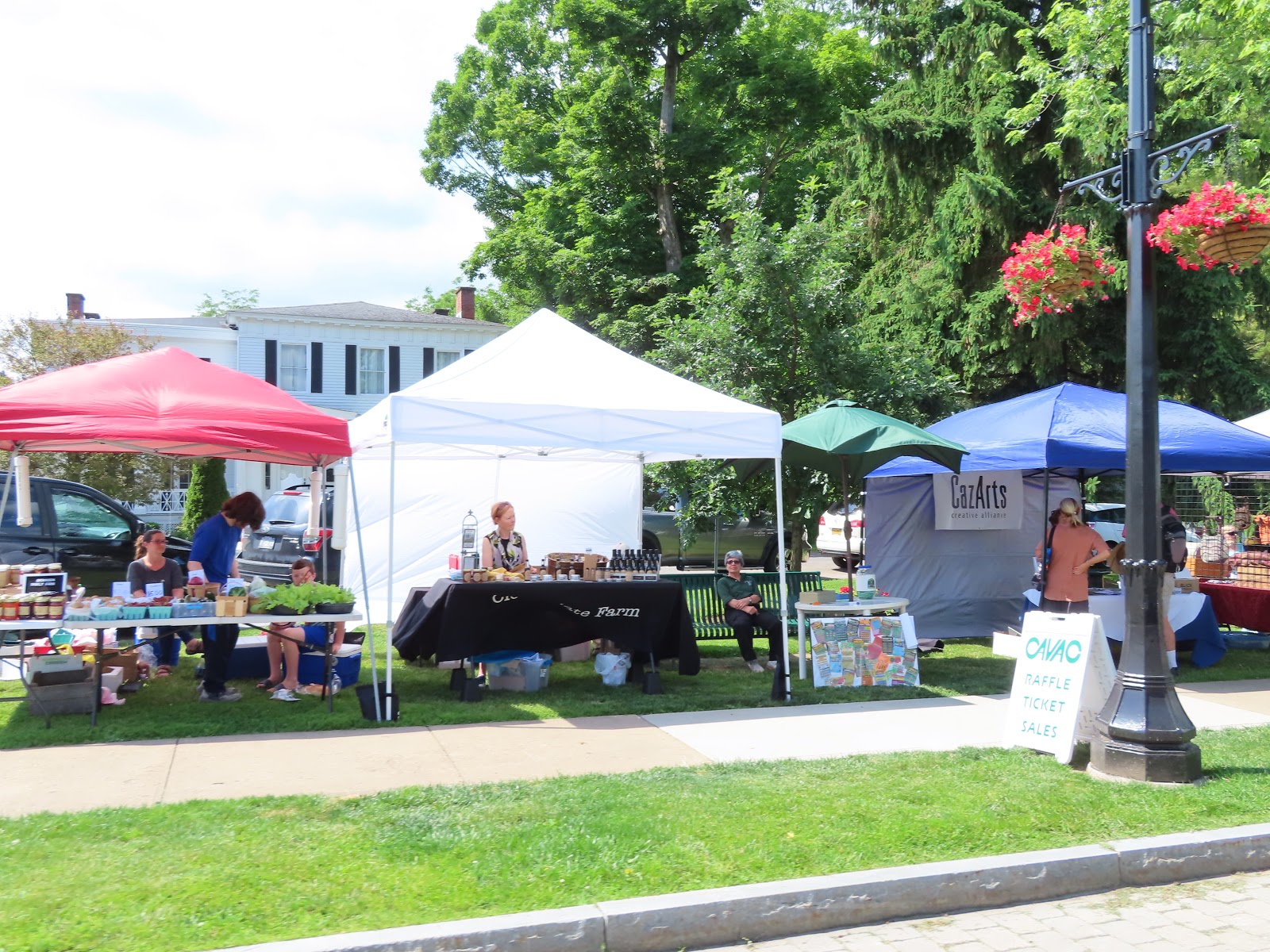
Driving into Cazenovia we came upon the weekly
summer time spectacular of a Farmers Market, plus. These occur every Saturday
during the summer. There are 25 local vendors selling everything from local
produce, meats, eggs, cheese, baked goods, adult beverages, vegan, gluten
friendly, and organic foods. Also maple syrup, plants, herbs, clothes, jewelry,
children’s toys and stories.


We came into Morrisville, NY. Currently
American Legion Boys State is at the Morrisville Campus. American Legion Boys
State is a week-long program that immerses high school youth (currently
completing their junior year) in citizenship and leadership training. They
learn the practical aspects of government as it exists in New York State, and
come to recognize that the individual is integral to the character and success
of government. They also participate in physical fitness, teamwork and other
activities, under the guidance of American Legion counselors and US Marines.
Our friends, Randy & Sheila’s boys, Trevor and Owen, are there now. I
wonder how they are doing?

We had seen signs along the way, but when we
arrived in Bouckville I was impressed with the Ye Olde Landmark Tavern. The
history of the beautiful and historic Landmark Tavern building begins with the
efforts to procure a canal route from Binghamton to Utica. This route would join the coal fields of
Northern Pennsylvania with the recently-opened Erie Canal. The farms, hamlets and villages of the
Chenango and Oriskany river valleys, through which the proposed canal was to be
constructed, had the potential for great prosperity if this new transportation
route were built. The construction of a canal offered the chance to drain the
swamps and create lowland farms that could use the rich alluvial soil of the
Bouckville area.

When news of the pending passage of the canal
bill became known many people began to plan new business ventures along the
canal route. Local farms were producing
an abundance of grain and the grain could be sent to market by wagon, but that
was a slow and laborious process. A
better way to transport the grain was to process it into whiskey and then send
it to market in barrels on the new Chenango Canal. As a result, a fine cobblestone building was
erected around 1837 on the west side of the canal and a distillery was born. The
building was purchased and converted into a vinegar manufacturer. Another story
tells that the Cobblestone Store had a way to hide runaway slaves during the
Civil War time period. The slaves were
supposedly hidden on the Chenango Canal boats by the boat captains. When the boats docked at Bouckville, the
runaways were secreted to the Cobblestone Store and hidden in a cavity just to
the right of the fireplace, which is located in the second dining room of the
Landmark Tavern.

The Town of Duanesburg was settled as early as
1736-1770 by investors such as William North, Thomas Freeman, Timothy Bagley,
William Crosby, Walter Butler and Jonathan Brewster. But by 1765, Judge James Duane
owned the largest share of the Town, which was named in Duane's honor.
Duanesburg received its first patent as a town March 13, 1765. Early on, James
Duane envisioned Duanesburg as the future capital of New York State, given his
influence as mayor of New York City, Federal Judge, friend of George Washington
and member of the First Continental Congress. And while this dream went by,
Duanesburg became an important railway center, boasting by 1907 the largest
coaling station in the world.

We entered the Hudson River Valley National
Heritage Area. The Hudson River Valley National Heritage Area was designated by
Congress in 1996 and is one of the now fifty-five federally-recognized National
Heritage Areas throughout the United States. Through a partnership with the
National Park Service, Hudson River Valley National Heritage Area collaborates
with other partners to interpret, preserve and celebrate the
nationally-significant cultural and natural resources of the Hudson River
Valley. This sign is outdated, because in March 2019, the Hudson River Valley
National Heritage Area (NHA) was officially renamed the Maurice D. Hinchey
Hudson River Valley National Heritage Area, in honor of the late Congressman
who wrote the legislation creating the NHA in 1996.

We arrived in Troy, the home of Uncle Sam. I will
talk more about Troy later, as we are here for a few days to enjoy time with
some of the guys I deployed to Iraq with.


